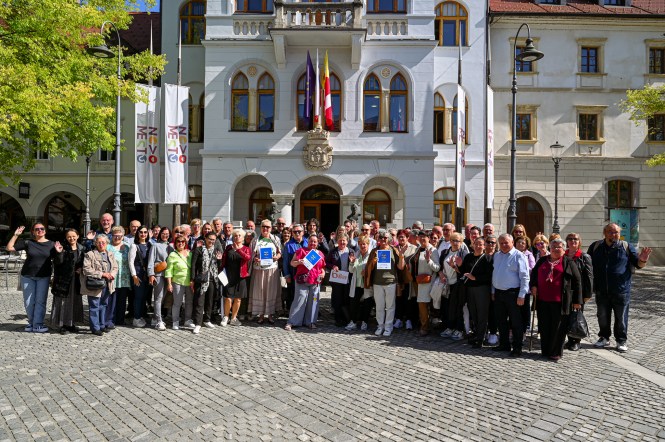
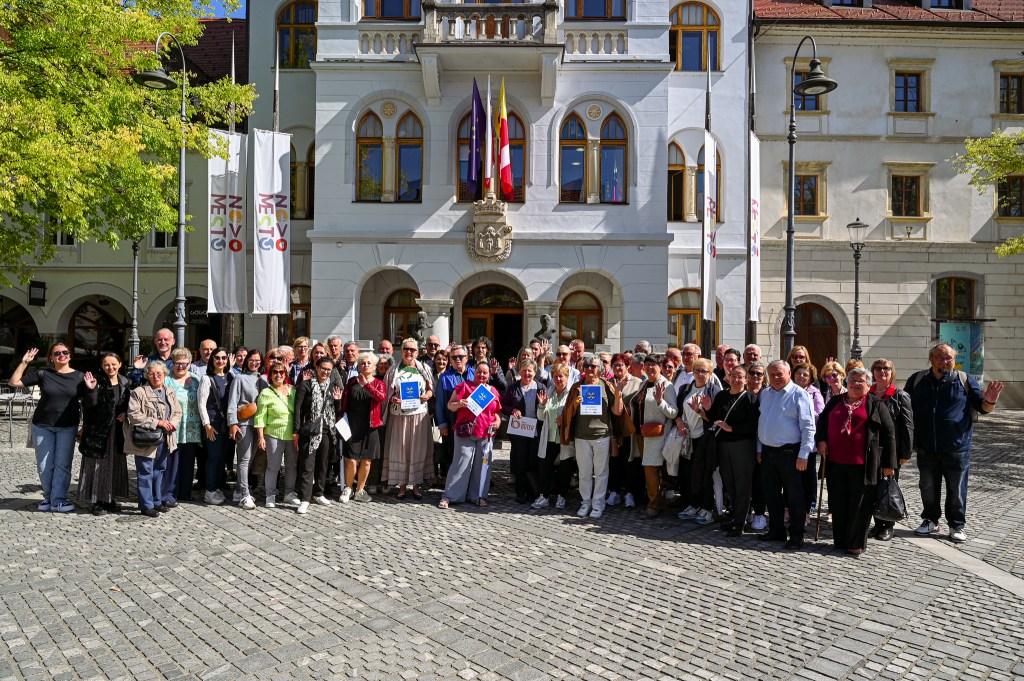
From 20 to 23 September 2026, Novo mesto hosted the international conference of the project Citizens from local communities – the value of the EU, known as EU citizens. Over four days, citizens and organisations from Slovenia, Malta, Serbia, Greece, Croatia, Bulgaria and Italy explored together what the European Union means for people in local communities, how citizens can take a more active part in shaping their towns, and how everyday choices, including the way we travel, contribute to a shared European future.
About the project
The project is coordinated by Zavod Boter, a non-profit organisation from Novo mesto committed to cultural, social and community development. It is co-funded by the European Union under the Citizens, Equality, Rights and Values (CERV) programme, within the Town Twinning strand.
CERV is one of the European Union’s funding programmes for the period 2021–2027. Its aim is to protect and promote the rights and values enshrined in the EU Treaties and the Charter of Fundamental Rights. The programme is built on four strands: Union values, equality, rights and gender equality, citizens’ engagement and participation, and Daphne, which focuses on preventing violence. The EU citizens project belongs to the strand on citizens’ engagement and participation, which is based on the belief that democracy is not only about voting every few years, but something we live every day, including by getting to know our neighbours from other European towns.
Town Twinning has existed for decades, yet it remains one of the most direct ways for citizens from different countries to meet in person rather than just read about each other in the news.
The project partners are Zavod Boter (Slovenia), Birgu Local Council (Malta), DANUBE 1245 (Serbia), the Social Innovation and Cohesion Institute (Greece), the Local Action Group Prigorje-Zagorje (Croatia), the Municipality of Strumyani (Bulgaria) and the Municipality of Soriano nel Cimino (Italy).
Why this project?
Towns in south-eastern Europe face surprisingly similar challenges. Urbanisation puts pressure on public spaces, climate change requires new habits, and migration raises questions about how we live together. Mobility is a good example: in many partner countries, the car remains the first choice for daily journeys, with consequences for the environment, traffic, public health and the quality of life in towns.
During the preparation of the project, the partners consulted local stakeholders, and the message was clear: people, especially young and older people, want a greater say in decision-making and stronger links with other European towns.
The overall objective of the project is to promote European values, such as diversity, solidarity and multiculturalism, through direct encounters between citizens of different European towns. The specific objectives include raising awareness of sustainable mobility, strengthening the capacity of local communities to benefit from EU membership, fostering intercultural dialogue, particularly among young people, exchanging good practices between towns, and building links that will last beyond the project.
Day one: arrival and getting to know each other
The conference began on Sunday, 20 September, when participants arrived in Novo mesto and settled at Hotel Pri Belokranjcu. The welcome dinner was the first opportunity for participants to meet. Introductions soon turned into conversations about home towns, languages, local traditions and expectations for the coming days. These first moments set the tone for the conference: open, friendly and curious about one another.
Day two: learning from local good practices
Monday, 21 September, was dedicated to local good practices in Novo mesto.
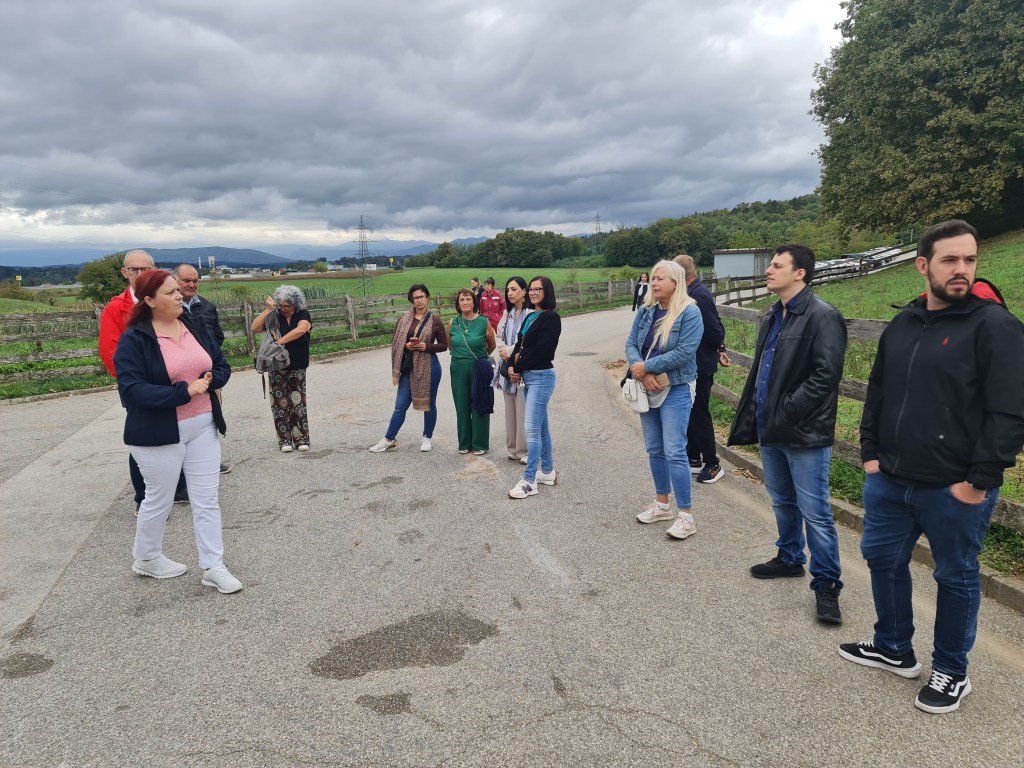
In the morning, participants visited Grm Novo mesto – Centre for Biotechnics and Tourism. Hosts presented the work of the whole centre and its role in education, agriculture, local food production and tourism. Participants saw how an educational institution can be closely connected with its region, giving young people practical skills and helping to preserve and develop local knowledge. The visit ended with a wine tasting and lunch, offering participants a taste of Dolenjska and its local products.
In the afternoon, the group visited the Home for Senior Citizens in Novo mesto. The hosts presented their activities as an example of good practice in elderly care and community inclusion, showing how older people can remain active and connected with the community. The visit led to a valuable exchange about solidarity between generations. Partners compared the situation in their countries and agreed that the way a community cares for its older members reflects its values. Dignity, equality and solidarity, the values at the heart of the European project, are lived first of all in local communities.
After free time, the day ended with dinner at Hotel Pri Belokranjcu.
Day three: European Car-Free Day and the EU citizens event
Tuesday, 22 September, was the central day of the conference. The date was chosen deliberately: the conference took place during European Mobility Week, and its main part coincided with the European Car-Free Day, when towns and cities across Europe give their streets back to people.
After breakfast, participants walked together to Glavni trg, the main square of Novo mesto, and joined the Car-Free Day alongside local citizens and visitors. The square, free of cars, became a space for walking, cycling, meeting and talking. For the international group, it was a practical experience of the topic they had come to discuss.
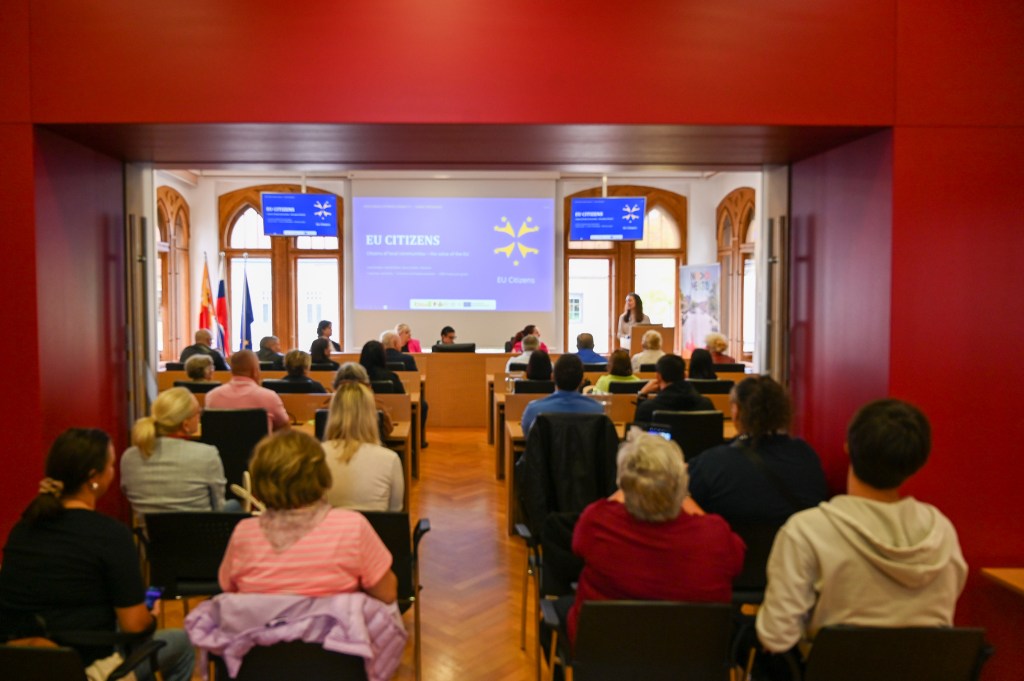
The participants then gathered at the Novo mesto Town Hall (Rotovž) for the central EU citizens event.
Welcome by the project manager
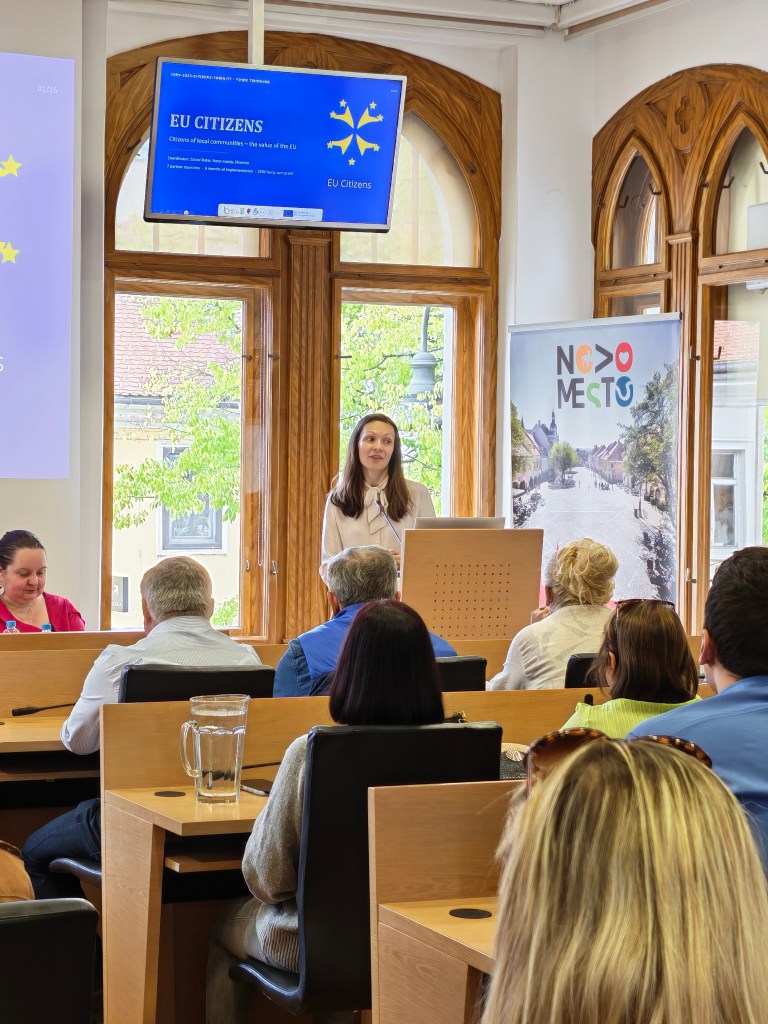
The event was opened by Ester Snedec, project manager at Zavod Boter. Welcoming partners and guests from seven countries, she said that Novo mesto was welcoming not only international guests, but also ideas, experiences, traditions, questions, hopes and visions from seven European countries. By coming together, she said, the participants were showing that local communities are not isolated places, but essential parts of a much larger European story.
She stressed the message behind the project title: European values become meaningful when citizens live them in their everyday communities. Democracy, solidarity, equality, cultural diversity, mutual understanding and active participation become real when people meet, listen to one another, exchange experiences and work together. She also highlighted sustainable mobility as an issue that affects everyone, as our daily travel choices are connected with the environment, the quality of life in our towns and villages, accessibility and social inclusion.
“The real value of this project cannot be measured only in numbers. Its greatest value lies in the encounters that take place between people,” she said. “Every conversation can challenge a stereotype. Every shared experience can open a new perspective. Every friendship created across borders can become a small but meaningful contribution to a more united Europe.”
She reminded participants that diversity is not a weakness or an obstacle to cooperation, but one of Europe’s greatest strengths, and that Europe is built through people: in local communities, schools, associations, municipalities, families and the everyday choices of citizens. She thanked the partner organisations, the local teams, volunteers and everyone who worked behind the scenes to prepare the conference.
Address by the Deputy Mayor of Novo mesto
Deputy Mayor of the City Municipality of Novo mesto Sara Tomšič then welcomed the participants on behalf of the town. She presented Novo mesto and its history, explained the meaning of Car-Free Day and spoke about the town’s approach to sustainability. She highlighted local good practices and the importance of a healthy lifestyle, including walking, cycling and the use of public transport to reduce pollution and make the town a better place to live.
Presentation of the project and the CERV programme
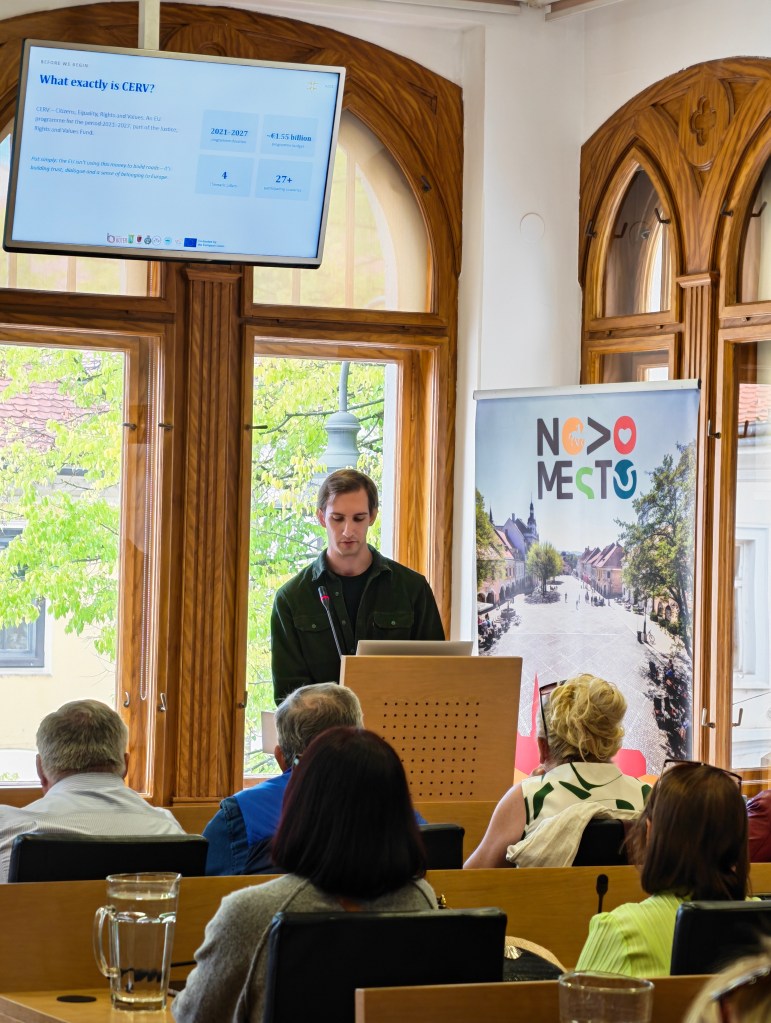
Andraž Prus presented the EU citizens project and the CERV programme. He opened with a smile, admitting that the phrase “EU project” often makes people think of forms and long documents, but that behind them lies something far more vibrant: people from different towns learning from one another.
He explained that CERV does not build roads or bridges, but invests in trust, dialogue and the feeling that, whether we live in Novo mesto or in Malta, we are part of the same story. He presented the project’s place within the Town Twinning strand, its partners and its objectives, and illustrated the topic of mobility with examples from partner countries, noting that reaching for the car keys is a surprisingly universal European habit, regardless of which side of the border we live on.
He also presented the project’s methodology in four connected phases: preparation and coordination; reflection and exchange through workshops, debates and peer learning, where participants are co-creators rather than passive listeners; multiplication and dissemination through local events and the media; and sustainability and evaluation, ending with recommendations for the future. He explained the expected results of the project, from new knowledge and first habits of sustainable mobility, such as walking, cycling and public transport, to stronger networks between towns and young people who become multipliers in their own communities.
Presentations of the partner countries
In the final part of the event, representatives of all partner organisations presented their countries and the towns they come from, in connection with the theme of the event. The presentations showed the rich diversity of the partner communities, from island and coastal towns to rural municipalities and historic centres, while also revealing many shared challenges: traffic and mobility, public spaces, the environment, the involvement of young and older people, and the wish of citizens to have a greater say in local decisions.
Lunch, the Herbal Centre Škocjan and the city tour
After the event, participants continued their conversations over lunch at Gostišče na trgu on the main square.
In the afternoon, the group from Croatia, who joined the conference for the central day, travelled by bus to the Herbal Centre Škocjan (Zeliščarski center Škocjan). They visited the herb garden and learned about the centre’s work. The visit was a fitting continuation of the topics of the day: it showed how sustainability, a healthy lifestyle and respect for nature can be part of local development and how traditional knowledge about herbs remains alive in the Slovenian countryside. After the visit, the group set off for home.
The other participants stayed in Novo mesto, where a guided tour introduced them to the history, heritage and stories of the town on the Krka river. The tour was followed by free time and dinner at Hotel Pri Belokranjcu.
Day four: farewell
On Wednesday, 23 September, after breakfast and some free time, participants set off for home, carrying with them new knowledge, new contacts and new ideas for their local communities.
What remains after the conference
The conference showed that European values are not abstract. They are visible in a school that connects young people with their region, in a home for older people that keeps its residents part of the community, in a main square given back to people for a day, and in a room full of citizens from seven countries discussing their towns and their future.
Perhaps the most important result of the conference cannot be written in a report: the personal connections between people who, a few days earlier, did not know each other. These connections are the foundation for future cooperation between the partner towns.
The project continues
The conference in Novo mesto was the central event of the project, but the story continues. Each partner will organise a local multiplier event in its own country, such as a public debate, workshop or presentation, to share the conclusions of the conference with local schools, clubs, environmental initiatives, businesses and public institutions. At the end of the project, the partners will sign a Memorandum of Cooperation, a formal commitment to keep the links between their towns alive after the end of the funding.
As Andraž Prus put it at the end of his presentation, six months is the timeframe of the project, but friendships between towns have no deadline. Seven towns have taken the first step together.
Thank you
Zavod Boter thanks all partner organisations, the City Municipality of Novo mesto and Deputy Mayor Sara Tomšič, Grm Novo mesto – Centre for Biotechnics and Tourism, the Home for Senior Citizens Novo mesto, the Herbal Centre Škocjan, Gostišče na trgu, Hotel Pri Belokranjcu, our guide, and all the participants, volunteers and colleagues who made the conference possible.
Disclaimer:
Co-funded by the European Union. Views and opinions expressed are however those of the author(s) only and do not necessarily reflect those of the European Union or the European Education and Culture Executive Agency (EACEA). Neither the European Union nor the granting authority can be held responsible for them.