Misinformation isn’t just about being wrong.
It’s about who gets denied treatment, who gets blamed, and who gets silenced.
Scientific literacy is a human rights skill.
The connection between misinformation and human rights is more direct than it first appears. Health misinformation costs lives — and it disproportionately costs them among people with the least access to reliable information and care. Pseudoscientific claims about groups of people have historically been the raw material of discrimination. And manufactured doubt — about what’s safe, what’s proven, what happened — erodes the informed consent and informed participation that rights frameworks depend on. A right you can be talked out of, or misled about, is a right you don’t fully have.
This is the premise of SciLit.eu: scientific literacy treated not as an academic virtue, but as a civic protection. The free platform launches this July, with 7 interactive modules — including one dedicated specifically to the relationship between evidence, rights, and action — built by six European organizations and co-funded by the EU through Erasmus+.
Pre–registration: https://scilit.eu
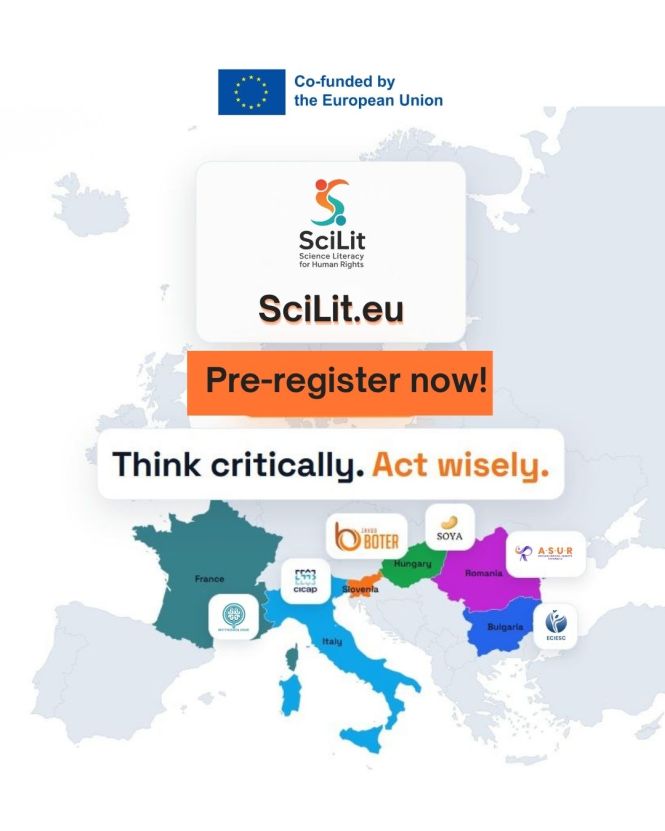
This is an Erasmus+ project developed by the Romanian Secular-Humanist Association in partnership with CICAP (Italy), Mythodologie (France), Zavod Boter (Slovenia), SOYA (Hungary) and ECIESC (Bulgaria). Co-funded by EU.

